
This manual provides features, specifications, installation, operation, and maintenance information for the Keyence GT Series high‑speed, high‑accuracy CCD…
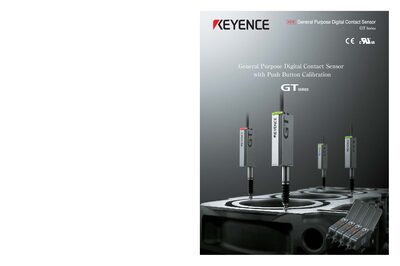
The GT Series sensor delivers high‑speed, high‑accuracy displacement measurement with a compact design. It offers a 10 mm to 22 mm measuring range, sub‑micron resolution, and strong environment resistance, including water‑resistance for harsh conditions. The sensor head includes a bright two‑color indicator for quick visual status checks.
The system uses panel‑mounting (GT‑75A) or DIN‑rail mounting (GT‑71A) amplifier units that can be linked together, reducing wiring complexity. Communication options include RS‑232C (DL‑RS1) and BCD (DL‑RB1) interfaces, and the co‑transformer method ensures absolute position tracking without the need for frequent zero‑point adjustments.
| Power supply voltage | 24 VDC |
|---|---|
| Current consumption (DL‑RB1) | 20 mA max. |
| Current consumption (DL‑RS1) | 18 mA max. |
| Maximum number of connectable amplifiers | 10 units |
| Environmental resistance (temperature) | ‑10 °C to +55 °C |
| Environmental resistance (humidity) | 35 % to 85 % |
| Weight (DL‑RB1) | ≈ 46 g |
| Weight (DL‑RS1) | ≈ 53 g |
| Tightening torque (locking collet) | 10 Nm |
The tightening torque is 10 Nm.
Up to 10 amplifiers, including the main unit, can be connected.
Yes, the co‑transformer method keeps the zero point even after power‑off.