
Everlight application notes explain using infrared emitting diodes in remote controls, including wavelength, carrier waves, distance, current, and duty cycle.
This Everlight application note explains the use of infrared emitting diodes (IR LEDs) in remote controls. It covers the 940 nm wavelength, carrier-wave frequencies, and the relationship between radiant intensity and transmission distance.
It also discusses viewing angle, forward current versus ambient temperature, and duty-cycle choices for increasing operating current. An example calculation and a recommended SMD part list are included.
| Remote control IR wavelength | 940 nm |
|---|---|
| Visible light range | 380-770 nm |
| Carrier wave frequency range | 30-60 kHz |
| Most common carrier frequency | 38 kHz |
| Example radiant intensity | about 20 mW/sr at IF=20 mA and 25 C |
| Example receiver sensitivity | about 0.25 mW/m2 |
| Example maximum continuous forward current | 50 mA |
| Example maximum forward current at 50% duty | 100 mA |
| Example maximum forward current at 30% duty | 150 mA |
| General carrier duty cycle options | 1/2, 1/3, and 1/4 |
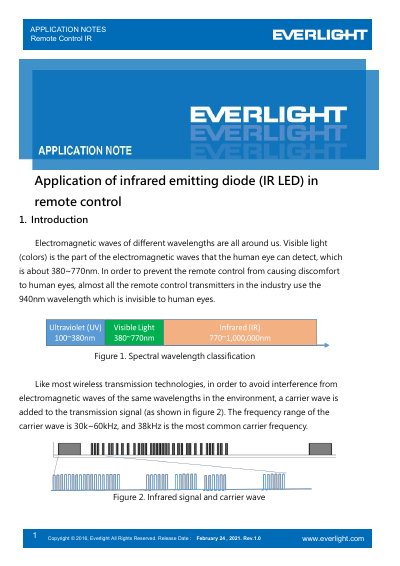
To avoid discomfort to human eyes, almost all remote control transmitters use the 940 nm wavelength, which is invisible to human eyes.
The carrier wave ranges from 30 kHz to 60 kHz, and 38 kHz is the most common carrier frequency.
A 1/3 duty cycle is recommended when balancing power saving and receiving distance; use 1/2 for better reception if power consumption is not a concern.