
The Cisco CRS-1 16 Routing CPU Manual provides specifications, interfaces, memory, power, and compliance details for the 16‑slot line‑card chassis processor.
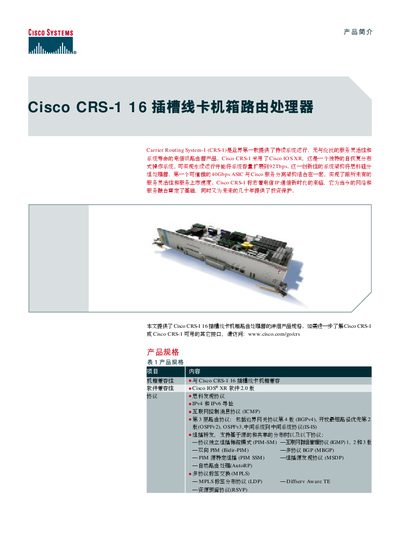
The Cisco CRS-1 16 is a carrier‑grade routing processor that runs Cisco IOS XR and supports a wide range of routing and transport protocols. It is designed for high availability, service flexibility, and long system life in telecom networks.
Key features include configurable 2 GB or 4 GB routing memory, dual 800 MHz PowerPC SMP CPUs, multiple Ethernet ports, extensive MIB support, and compliance with numerous safety and NEBS standards. Physical specifications such as weight, dimensions, and power consumption are also listed. This manual is written in Chinese.
| Weight | 12.8 lb (5.8 kg) |
|---|---|
| Width | 2.8 in (7.1 cm) |
| Height | 20.6 in (52.2 cm) |
| Depth | 11.2 in (28.4 cm) |
| Power Supply | 350 W |
| Routing Memory | Configurable 2 GB or 4 GB |
| Boot Flash | 64 MB |
| Hard Disk | 1 × 40 GB |
| NVRAM | 2 MB |
| CPU | 2 × 800 MHz PowerPC SMP |
It runs Cisco IOS XR.
It supports BGPv4, OSPFv2, OSPFv3, IS‑IS, and other standard IP routing protocols.
The chassis weighs 12.8 lb, is 2.8 in wide, 20.6 in high, and 11.2 in deep.
It requires a 350 W power supply.