
The Analog Devices MT-068 application guide explains differential amplifier principles, design considerations, and example circuits for current‑sensing.
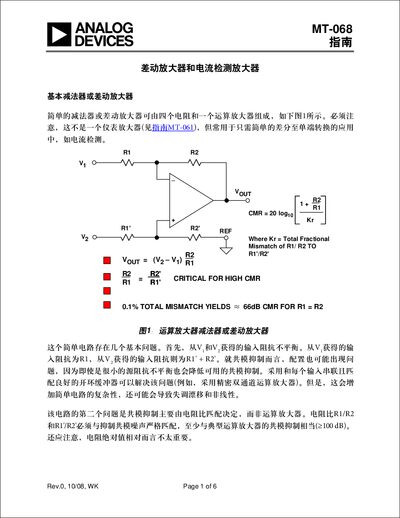
This guide introduces the basic differential amplifier built from four resistors and an op‑amp, highlighting the importance of resistor matching for achieving high common‑mode rejection (CMRR). It explains how mismatched resistors degrade CMRR and discusses techniques such as using precision matched resistor networks.
Several example amplifiers are presented, including the AMP03 precision differential amplifier, AD629, AD8202, and AD8210. Their specifications, typical circuit configurations, and application notes for current‑sensing and high‑voltage measurements are described, along with reference designs and component recommendations. This manual is written in Chinese.
| AMP03 CMRR | 100 dB |
|---|---|
| AMP03 Small‑signal bandwidth | 3 MHz |
| AD629 Common‑mode voltage | ±270 V |
| AD629 Supply voltage | ±15 V |
| AD629 Small‑signal bandwidth | 500 kHz |
| AD8202 Input common‑mode voltage | up to 28 V |
| AD8202 Total CMRR | 80 dB |
| AD8202 Supply voltage range | 3.5 V – 12 V |
| AD8210 Common‑mode voltage | up to 65 V |
A total mismatch of 0.1 % yields about 66 dB CMRR, while a 1 % mismatch can reduce CMRR to roughly 46 dB.
The AD629 differential amplifier is specified for ±270 V common‑mode voltage.
AMP03 provides a typical common‑mode rejection ratio of 100 dB.
AD8202 operates from a single supply of 3.5 V to 12 V.