
This document describes the features and specifications of the PCE-HT 150 hardness tester.
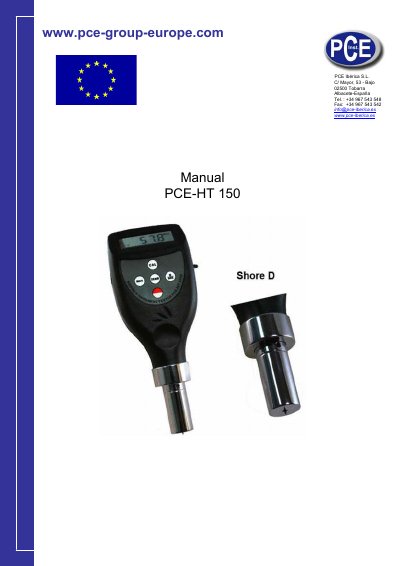
The PCE PCE-HT 150 is a hardness tester for determining penetration hardness of materials from cellular products to rigid plastics. Shore A, C, and D versions cover rubber, elastomers, foams, plastics, and similar materials, and the tester complies with DIN 53505, ISO 868, ISO 7619, ASTM D 2240, and JIS K7215. It uses a digital LCD display and can connect to a PC through an optional RS232C cable and software.
The manual describes front-panel controls, measurement procedure, maximum and average readings, zero and high-point calibration checks, battery replacement, and operating notes. It also lists specifications such as range, resolution, power supply, dimensions, weight, and operating conditions. This manual is written in Spanish.
| Display | 4 digits, 10 mm LCD |
|---|---|
| Range | 10~90 H(A, C, D) |
| Resolution | 0.1 |
| Measurement deviation | error 1 |
| Power supply | 4 x 1.5 V AA (UM-3) batteries |
| Operating conditions | Temperature 0~50; humidity <80% |
| Dimensions | 162 x 65 x 28 mm (6.4 x 2.6 x 1.1 in) |
| Weight | about 170 g (without batteries) |
| PC interface | RS232C |
| Shutdown | 2 modes: manual or automatic after 2 minutes |
| Compliance | DIN 53505, ISO 868, ISO 7619, ASTM D 2240, JIS K7215 |
| Included accessories | Transport bag, operation manual, test block |
| Optional accessory | RS232C cable and software |
The Shore A model is designed for rubber, elastomers, neoprene, silicone, vinyl, soft plastics, felt, leather, and similar materials.
Shore A requires at least 6 mm and Shore D requires at least 3 mm.
Hold the tester vertically with the penetrator suspended in air; if the reading is not 0, press ZERO.
Replace the batteries when the battery symbol appears on the display.