
This document introduces the features and characteristics of the STEVAL-MKI103V1 MEMS demonstration board based on the LPY410AL (dual-axis pitch and yaw ±100 dps analog gyroscope). The demonstration board provides two different working modes: analog (AWM) and digital (DWM).
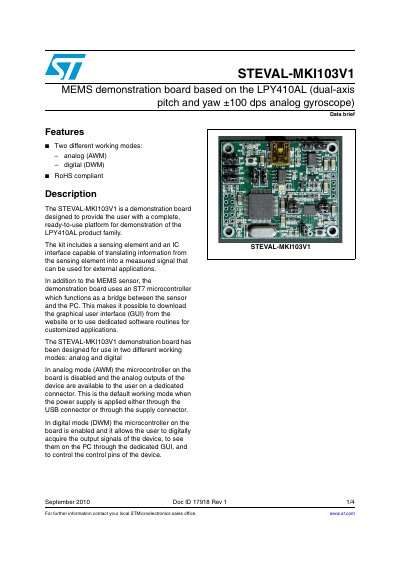
The STEVAL-MKI103V1 is a demonstration board designed for the LPY410AL product family, which includes a dual-axis pitch and yaw MEMS gyroscope with +100 dps capability. The kit provides a ready-to-use platform that includes a sensing element and an IC interface to translate sensor information into measurable signals for external applications.
The board is a MEMS demonstration board based on the LPY410AL dual-axis pitch and yaw analog gyroscope.
The device operates in either analog mode where the microcontroller is disabled, or digital mode where it is enabled.
The board enters its default working mode, which is analog mode with the microcontroller disabled.