
This application note describes how to implement the power-on self test features in locked step on SPC56EL60
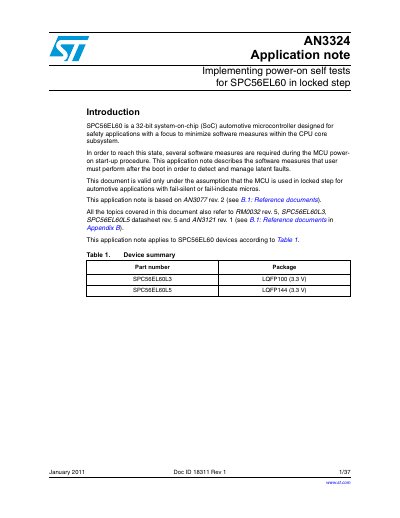
This document provides guidance on how to implement power-on self-test features for the SPC56EL60 system-on-chip (SoC) designed for safety-critical automotive applications. It focuses on minimizing software measures within the CPU core subsystem while ensuring latent faults are detected and managed during the MCU startup procedure.
The note details specific software requirements for various non-applicative peripherals, including the System Status and Configuration Module (SSCM), Self Test Control Unit (STCU), Redundancy Control Checker Unit (RCCU), Reset Generation Module (MC_RGM), Fault Collection and Control Unit (FCCU), Clock Monitor Unit (CMU), Flash memory integrity checks, Temperature Sensors, Software Watchdog Timer (SWT), Power Management Unit (PMU), and Analog to Digital Converter (ADC). It also covers applicative peripherals like the ADC self-test algorithms.
| Device Type | 32-bit system-on-chip (SoC) automotive microcontroller |
|---|---|
| Application Focus | Safety applications with fail-silent or fail-indicate micros |
| Supported Part Numbers | SPCS6EL60L3, SPCS6EL60L5 |
The goal is to show how users can implement properly the safety initialization and self tests to allow detecting latent faults and managing them.
They must be configured before all monitors or detectors are initialized.