
This document compares the hardware and software differences between two 32-bit automotive microcontrollers, SPC560P50 and SPC56AP60. It covers the differences in device pinout and pin multiplexing, clock distribution and management, Flash memory, etc.
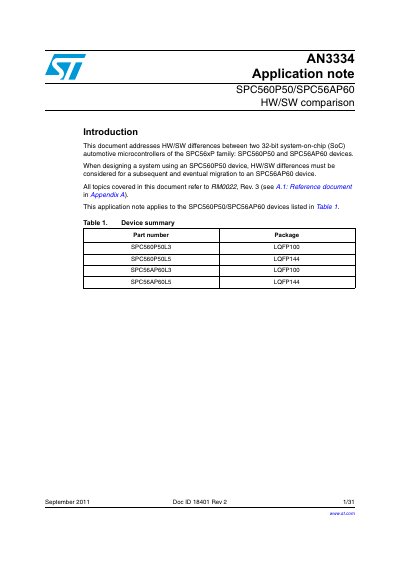
This document addresses the hardware and software differences between two 32-bit system-on-chip (SoC) automotive microcontrollers of the SPC56xP family: the SPC560P50 and the SPC56AP60. It is designed to help engineers consider necessary differences when designing a system using an SPC560P50 device with the intention of migrating to an SPC56AP60 device later.
The note covers various technical aspects including device pinout and pin multiplexing, clock distribution and management, flash memory features, interrupts, and specific peripherals such as FlexRay, LINFlex, and ADCs. It provides detailed comparisons of features like core architecture, memory sizes, peripheral counts, and package types, alongside specific notes on pin multiplexing changes and circuit adaptations required for the newer device.
| Core | SPC560P50: Single-core e200z0h; SPC56AP60: Dual-core e200z0h |
|---|---|
| System clock | Up to 64 MHz |
| Code Flash memory | SPC560P50: 512 Kbyte; SPC56AP60: 1024 Kbyte |
| SRAM | SPC560P50: 40 Kbyte; SPC56AP60: 80 Kbyte |
| FlexCAN | SPC560P50: 2 x (32 MB); SPC56AP60: 3 x (32 MB) |
| Supply voltage | 3.3 V or 5 V single supply with external ballast transistor |
| Temperature range | -40 to 125 °C |
To address HW/SW differences between the SPC560P50 and SPC56AP60 devices for potential migration.
Yes, the SPC56AP60 pin multiplexing is based on the SPC560P50 to ensure full compatibility.
The SPC56AP60 has an integrated pull-down resistor on the BCTRL pin, whereas the SPC560P50 requires an external pull-down resistor.