
STMicroelectronics AN925 Time Update in TIMEKEEPER Devices Application Note

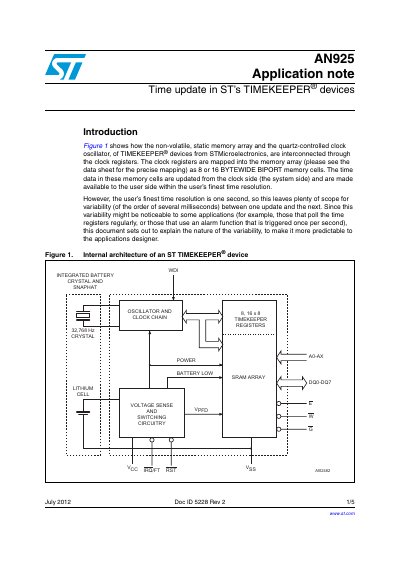
This document describes how the non-volatile static memory array and the quartz-controlled clock oscillator in STMicroelectronics' TIMEKEEPER® devices are interconnected, and how the time data is updated.

STMicroelectronics AN925 Time Update in TIMEKEEPER Devices Application Note - cover page
Brand
STMicroelectronics
Category
Other Electronics
Document type
Application Note
Language
English
Pages
5
File format
PDF
File size
120 KB
Published
06 August, 2012
Updated
29 September, 2023
MD5 checksum
695C1C3C48D906A88A6B9279193C67F4

About this manual

This document explains the nature of variability in time updates for STMicroelectronics TIMEKEEPER® devices. It details how non-volatile memory and clock oscillators are interconnected and how time data is updated from the system side to the user side. The variability, which can range from 0.5 ms to 3.5 ms, is caused by ripple carries through the seven clock registers (seconds, minutes, hours, day, date, month, year) during updates.

What's inside

  • Introduction
  • Internal Architecture
  • Time Update Variability
  • Ripple Carry Mechanism
  • System-to-User Update Pulse
  • Fixed Delay Approach
  • Variable Delay Approach
  • Device Examples
  • Revision History
  • Disclaimer

Frequently asked questions

What is the range of the delay between successive System-to-User-Update-Pulses in older TIMEKEEPER devices?

The delay can vary from 0.5 ms to 3.5 ms.

Which TIMEKEEPER devices use a fixed delay approach for time updates?

Newer devices such as M48T02, M48T12, M48T08/Y, M48T18, M48T58/Y (revision C), M48T35/Y, M48T35AV, M48T37Y/V and M48T201Y/V use a fixed delay.

What is the constant delay time for the fixed delay approach?

Each pulse is delayed by the same delta time of 3.5 ms.

Download PDF (120 KB)

More STMicroelectronics Manuals


View all STMicroelectronics manuals →