
This application note describes a problem that can occur with battery-powered NVRAM devices: negative undershoot can cause data corruption. This note provides advice on how to prevent this problem.
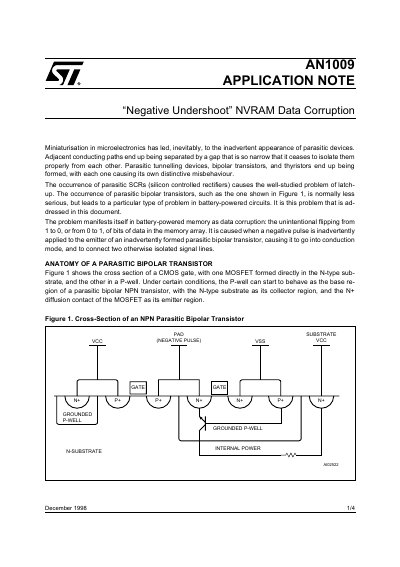
The document addresses the problem of inadvertent data corruption (bit flipping) in battery-powered memory arrays caused by parasitic bipolar transistors. This occurs when a negative pulse is applied to specific pins, causing the transistor to conduct and pull down the internal substrate voltage below critical levels.
To prevent this issue, the note advises designers on remedies including improving signal cleanliness, clamping power lines with Schottky diodes, cleaning up the power supply behavior during power-on/off cycles, and protecting individual susceptible pins.
| Trigger Voltage for Parasitic Turn-On | -0.6 V |
|---|---|
| Current Drain Threshold (Substrate Impact) | -0.6 mA |
| Recommended Diode Vp | approximately 0.32 V |
| Recommended Diode Current Rating | 100 mA |
| Maximum Pin Voltage Limit | -0.3 V |
Data corruption is caused by a negative pulse inadvertently applied to the emitter of an inadvertently formed parasitic bipolar transistor, which connects otherwise isolated signal lines.
All pins connected to N+ diffusion in a P-well on an N-type substrate are susceptible, with special attention required for the Vcc pin.