
This is an application note that describes the various options for receiving a subcarrier reference frequency for the AD722, including a logic-level (TTL) clock signal, a series resonant crystal, and a parallel resonant crystal. It also describes how to select between two different crystals in systems that offer both NTSC and PAL operation.
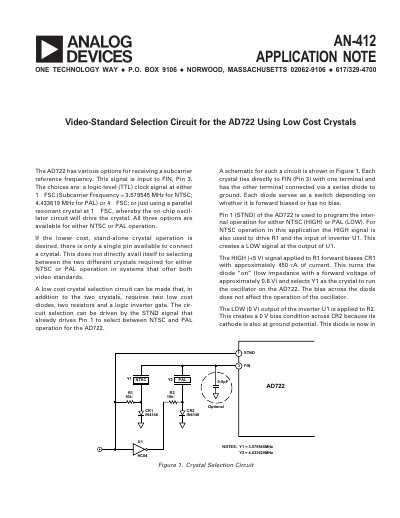
The document details how to implement a cost-effective crystal selection circuit for the AD722 chip. It explains that while the chip supports various subcarrier reference frequencies, selecting between crystals required for NTSC (3.579545 MHz) and PAL (4.433619 MHz) systems can be achieved using two low-cost diodes, resistors, a logic inverter gate, and the existing STND signal pin.
The circuit requires two crystals, two diodes, two resistors, and a logic inverter gate.
The STND signal drives R1 forward biasing CR1, which turns the diode on to select Y1 as the crystal.
Approximately 10 pF was found to be required across either crystal for proper tuning.