
Analog Devices AN-579 Versatile Programmable Amplifiers Using Digital Potentiometers

This article describes the concept of a versatile programmable amplifier using digital potentiometers with nonvolatile memory. By replacing mechanical potentiometers, the AD523x series of digital potentiometers mentioned in this article can improve the resolution and stability of the adjustment circuit.
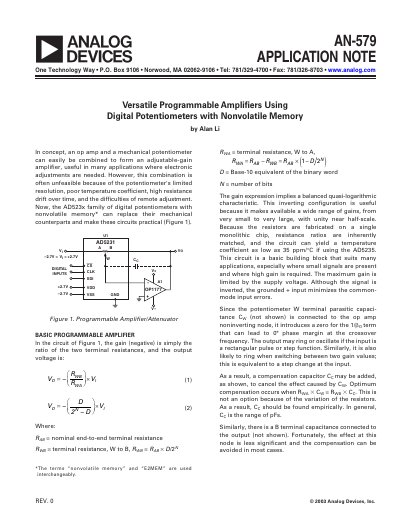

Analog Devices AN-579 Versatile Programmable Amplifiers Using Digital Potentiometers - cover page
Brand
Analog Devices
Category
Other Electronics
Document type
Application Note
Language
English
Pages
4
File format
PDF
File size
90 KB
Published
02 August, 2012
Updated
29 September, 2023
MD5 checksum
7924D84B7D9AEC04D07564030770F696

About this manual

This document describes circuits that use the AD523x family of digital potentiometers with nonvolatile memory to create programmable amplifiers and attenuators. These circuits address limitations of mechanical potentiometers, such as limited resolution, poor temperature coefficients, and resistance drift over time. The text details a basic inverting configuration and a bipolar programmable-gain amplifier with linear step adjustment.

What's inside

  • Programmable Amplifier/Attenuator
  • Bipolar Programmable-Gain Amplifier
  • Linear Step Adjustment
  • Compensation Capacitor
  • High Input Voltage Handling
  • Digital Potentiometer Selection

Frequently asked questions

What is the maximum temperature coefficient achievable with this circuit?

The circuit can yield a temperature coefficient as low as 35 ppm/°C if using the AD5235.

What is the typical range of wiper resistance for these digital potentiometers?

The wiper resistance is typically between 50 Ω and 100 Ω.

What happens if the voltage across the digital potentiometer exceeds 5 V?

Discrete resistors must be added in series with the potentiometers to comply with the voltage limitation.

Download PDF (90 KB)

More Analog Devices Manuals


View all Analog Devices manuals →