
Altera Basestation Channel Card Design Guide

This document discusses the technology of designing basestation channel cards, and how Altera's 28-nm FPGA and ASIC technology, along with software tools, development boards, IP, and reference designs, enable future-proof and differentiated designs.
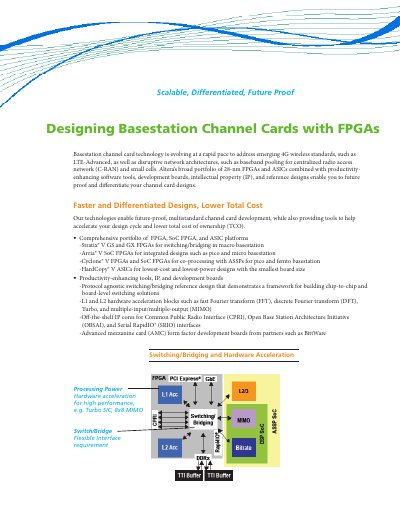

Altera Basestation Channel Card Design Guide - cover page
Brand
Altera
Category
Other Electronics
Document type
Product Leaflet
Language
English
Pages
2
File format
PDF
File size
131 KB
Published
01 August, 2012
Updated
29 September, 2023
MD5 checksum
76B64591CCEC8428957CEBA152F201A6

About this manual

Altera's broad portfolio of 28-nm FPGAs and ASICs, combined with productivity-enhancing software tools and reference designs, supports the development of scalable and differentiated basestation channel cards. The technologies address emerging 4G wireless standards like LTE-Advanced and disruptive network architectures such as baseband pooling for C-RAN and small cells.

What's inside

  • Basestation channel card technology
  • FPGA and ASIC platforms
  • Productivity-enhancing tools
  • LTE PUSCH uplink bitrate reference design
  • LTE symbol rate blocks
  • Layer 2 hardware acceleration
  • Timing and synchronization cores
  • Connectivity cores

Frequently asked questions

What wireless standards does this channel card technology address?

The technology addresses emerging 4G wireless standards such as LTE-Advanced.

Which FPGA platforms are used for switching in macro basestations?

Stratix V GS and GX FPGAs are used for switching/bridging in macro basestation.

What interfaces does the Altera ecosystem offer for connectivity cores?

The suite offers commodity interfaces such as CPRI, OBSAI, SRIO, PCIe, and GigE.

Download PDF (131 KB)

More Altera Manuals


View all Altera manuals →