
This document provides the absolute maximum ratings and electrical characteristics of the KST4403 PNP epitaxial silicon transistor. It includes information on its operating voltages, currents, power dissipation, and temperature range. Additionally, it provides details on its basic parameters such as collector-base breakdown voltage, collector-emitter breakdown voltage, emitter-base breakdown voltage, base cutoff current, collector cutoff current, DC current gain, saturation voltage, current gain bandwidth product, output capacitance, and turn-on/off times.
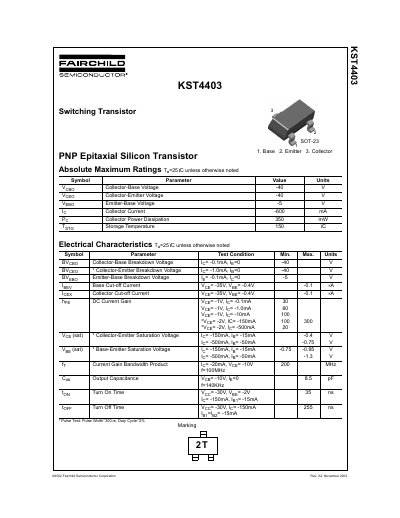
This document provides the design specifications for the KST4403, a PNP epitaxial silicon switching transistor packaged in SOT-23. It details absolute maximum ratings, electrical characteristics such as current gain and breakdown voltages, and typical performance curves.
| Collector-Base Voltage | -40 V |
|---|---|
| Collector-Emitter Voltage | -40 V |
| Emitter-Base Voltage | 5 V |
| Collector Current | -600 mA |
| Collector Power Dissipation | 350 mW |
| Storage Temperature | 150 °C |
| DC Current Gain | 30 to 300 |
| Package Type | SOT-23 |
The maximum collector current is -600 mA.
The device is available in an SOT-23 package.
The storage temperature range is up to 150 °C.