
NUP1105L is an Onsemi single line LIN/CAN bus protector, which is packaged in SOT-23. It provides bidirectional protection for the data line, offering a low cost option for system designers to improve system reliability and meet stringent EMI requirements.
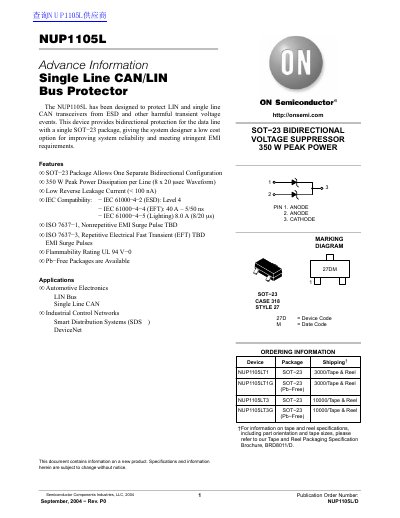
The NUP1105L is a bidirectional transient voltage suppressor (TVS) device designed to protect LIN and single line CAN transceivers from electrostatic discharge (ESD) and other harmful transient voltage events. It is housed in a compact SOT-23 package, offering a low-cost solution for improving system reliability and meeting stringent EMI requirements. The device is compatible with various automotive and industrial standards, including IEC 61000-4-2 for ESD and IEC 61000-4-4 for EFT.
| Peak Power Dissipation | 350 W |
|---|---|
| Operating Junction Temperature Range | -40 to 125 °C |
| Reverse Leakage Current | < 100 nA |
| ESD Rating (Contact) | 30 kV |
| Maximum Peak Pulse Current | 8.0 A |
| Package Type | SOT-23 |
The device is designed to protect LIN and single line CAN transceivers from ESD and other harmful transient voltage events.
Yes, it is compatible with IEC 61000-4-2 (ESD) Level 4.
The maximum operating junction temperature is 125 °C.