
The NCV1009 is a precision trimmed 2.5 V ±5.0 mV shunt regulator diode. The low dynamic impedance and wide operating current range enhances its versatility. The tight reference tolerance is achieved by on−chip trimming which minimizes voltage tolerance and temperature drift. A third terminal allows the reference voltage to be adjusted ±5.0% to calibrate out system errors. In many applications, the NCV1009Z can be used as a pin−to−pin replacement of the LT1009CZ and the LM136Z−2.5 with the external trim network eliminated.
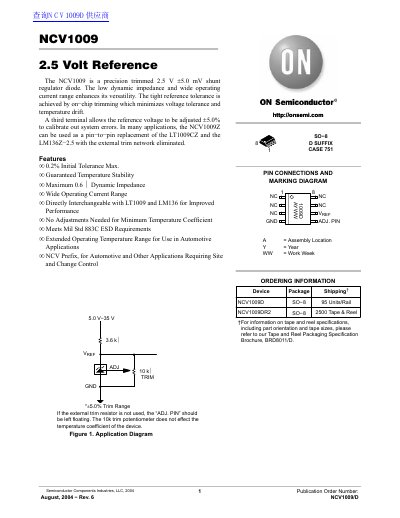
The NCV1009 is a precision trimmed 2.5 V +5.0 mV shunt regulator diode designed for versatility with a wide operating current range. It features low dynamic impedance and tight reference tolerance achieved through on-chip trimming, minimizing voltage tolerance and temperature drift. A third terminal allows the reference voltage to be adjusted by up to 5.0% to calibrate out system errors.
| Reference Voltage | 2.5 V +5.0 mV |
|---|---|
| Initial Tolerance | 0.2% Max |
| Dynamic Impedance | 0.2 Q Max |
| Operating Temperature Range | -40 to +125 °C |
| Trim Range | +5.0% |
Yes, the NCV1009Z can be used as a pin-to-pin replacement for the LT1009CZ and LM136Z-2.5.
The maximum dynamic impedance is 0.6 Ohms.
No, no adjustments are needed for the minimum temperature coefficient.