
The MC1455 is a highly stable timing circuit capable of producing accurate time delays or oscillation. It has additional terminals for triggering or resetting if desired. In the time delay mode, time is precisely controlled by one external resistor and capacitor. For astable operation as an oscillator, the free-running frequency and the duty cycle are both accurately controlled with two external resistors and one capacitor. The circuit may be triggered and reset on falling waveforms, and the output structure can source or sink up to 200 mA or drive MTTL circuits.
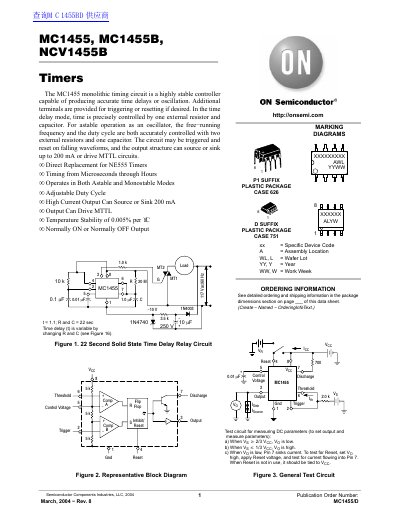
The document describes the MC1455, MC1455B, and NCV1455B monolithic timing circuits. These devices are capable of producing accurate time delays or oscillation in both monostable (one-shot) and astable modes. The circuit includes two comparators, a flip-flop, and a digital output, allowing it to be triggered and reset on falling waveforms.
| Supply Voltage Range | 4.5 to 16 Vdc |
|---|---|
| Power Dissipation P1 Suffix | 625 mW |
| Operating Temperature Range MC1455B | -40 to +85 C |
| Operating Temperature Range NCV1455B | -40 to +125 C |
The time that the output is high is given by the equation t = 1.1 Ra C.
Charge time is t1 = 0.695(Ra + Rp)C and discharge time is t2 = 0.695(Rp)C.
Yes, the output structure can source or sink up to 200 mA or drive MTTL circuits.