
The NUP4108W5 is a low capacitance quad array ESD protection device designed by Semiconductor Components Industries. It is suitable for applications requiring transient overvoltage protection, such as computers, printers, business machines, communication systems, medical equipment, etc. This device uses SC-88A SMT packaging and has the characteristics of small size, low power consumption and low capacitance.
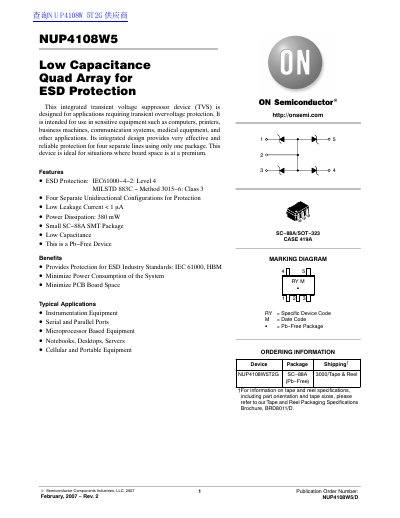
The NUP4108W5 is an integrated transient voltage suppressor (TVS) device designed to provide effective and reliable protection for four separate lines using a single SC-88A SMT package. It is intended for use in sensitive equipment such as computers, printers, business machines, communication systems, and medical equipment, particularly where board space is at a premium.
| Peak Power Dissipation | 20 W |
|---|---|
| Steady State Power Dissipation | 380 mW |
| Operating Junction Temperature Range | -40 to +125 °C |
| Breakdown Voltage | 64 to 71 V |
| Leakage Current | 1.0 pA |
| Clamping Voltage | 13 V |
| Maximum Peak Pulse Current | 1.6 A |
| Junction Capacitance | 12 to 15 pF |
The maximum peak power dissipation is 20 W.
The operating junction temperature range is from -40 to +125 °C.
The maximum clamping voltage is 13 V.