
ATS632LSC HALL-EFFECT GEAR-TOOTH SENSOR SUBASSEMBLY is a zero-speed, self-calibrating, non-oriented, hall-effect gear-tooth sensor.
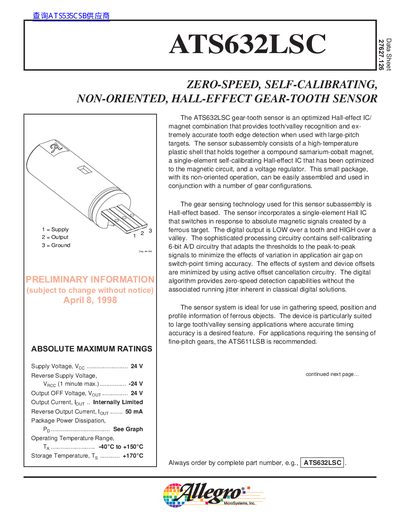
The ATS632LSC is a fully optimized gear-tooth sensor subassembly consisting of a high-temperature plastic shell holding a compound samarium-cobalt magnet and a single-element self-calibrating Hall-effect IC. It provides tooth/valley recognition and extremely accurate tooth edge detection when used with large-pitch targets, featuring non-oriented operation for easy assembly.
| Output Leakage Current | -5.0 to 10 mA |
|---|---|
| Supply Current (Output OFF) | -9.0 to 15 mA |
| Operating Air Gap Range | 0.3 to 1.9 mm |
| Timing Accuracy (Target Speed < 3500 RPM) | +/- 0.25 degrees |
| Operating Temperature Range (Tj) | -40°C to +150°C |
The device requires 16 output pulses after power on for the startup calibration to be complete.
The threshold calibration updates every 64 output pulses if necessary.
No, it is a non-oriented sensor that can be easily assembled without specific orientation.