
Introduction to the structure and working principle of power MOSFETs and its applications
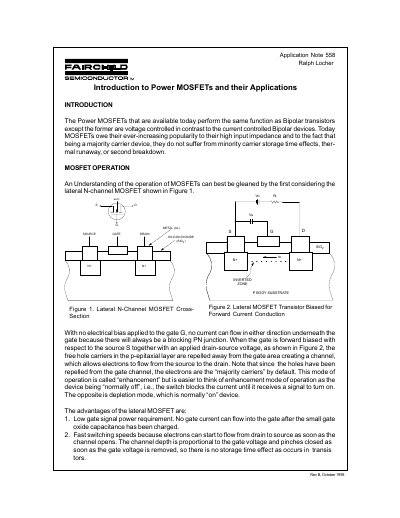
The document introduces Power MOSFETs as voltage-controlled devices that offer high input impedance and avoid minority carrier storage time effects found in Bipolar transistors. It details the difference between enhancement mode (normally off) and depletion mode operation.
The text further distinguishes between lateral and vertical MOSFET structures, highlighting the benefits of vertical DMOS designs for lower on-state resistance and faster switching speeds. Finally, it discusses parasitic capacitances, dV/dt turn-on issues caused by internal NPN transistors, and output characteristics.
Power MOSFETs are voltage controlled, whereas Bipolar devices are current controlled.
It acts like a switch that blocks current until it receives a signal to turn on.