
CMPSH05-4C is a dual common cathode high current, low VF silicon Schottky diode with a working voltage of 40V. It is packaged in a SOT-23F surface mount case and is suitable for small signal general purpose applications, providing a compact size and high efficiency.
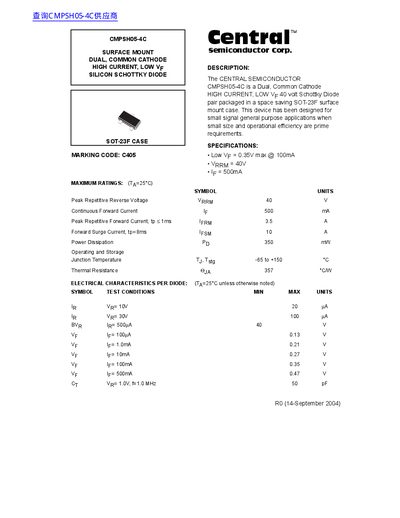
The Central Semiconductor CMPSH05-4C is a Dual, Common Cathode High Current, Low Vr 40 volt Schottky Diode pair packaged in a space saving SOT-23F surface mount case. This device has been designed for small signal general purpose applications when small size and operational efficiency are prime requirements.
The component features maximum ratings including a Peak Repetitive Reverse Voltage of 40V, a Continuous Forward Current of 500mA, and a Power Dissipation of 350mW. The operating and storage temperature range is -65 to +150 °C.
| Peak Repetitive Reverse Voltage (VRRM) | 40 V |
|---|---|
| Continuous Forward Current (IF) | 500 mA |
| Peak Repetitive Reverse Voltage @ IR=500uA | 40 V |
| Forward Voltage (VF) Max @ 100mA | 0.35 V |
| Power Dissipation (Pd) | 350 mW |
| Operating and Storage Temperature Range | -65 to +150 °C |
The maximum continuous forward current is 500 mA.
The maximum peak repetitive reverse voltage is 40 V.
The maximum power dissipation is 350 mW.