
74F373/74F374 are octal transparent latch and octal D flip-flop produced by Philips company. They have 3-State output and no glitch during power-up and power-down. They can independently control register and 3-State buffer. The package is SSOP Type II.
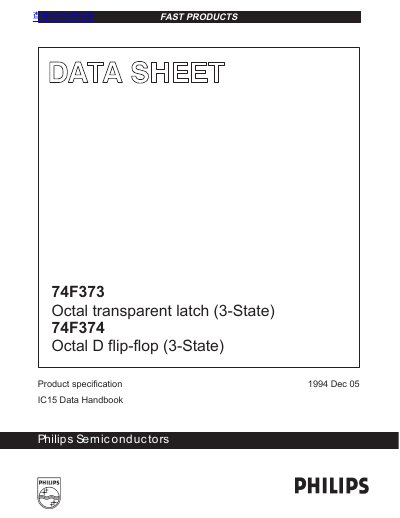
This datasheet provides technical specifications for the Philips 74F373 and 74F374 integrated circuits. The 74F373 is an octal transparent latch with 3-State outputs, while the 74F374 is an octal D-type flip-flop with 3-State outputs. Both devices are designed to drive heavily loaded 3-State buses, MOS memories, or MOS microprocessors.
| Package Type | SSOP Type II |
|---|---|
| Operating Temperature | 0°C to +70°C |
| Max Clock Frequency (74F374) | 165 MHz |
| Max Clock Frequency (74F373) | 150 MHz |
| Output Current (High) | 3.0 mA |
| Output Current (Low) | 24 mA |
The 74F373 is an octal transparent latch, while the 74F374 is an 8-bit positive edge triggered register.
The recommended supply voltage is 5.0V, with a range of 4.5V to 5.5V.