
LMC568 is a low power Phase-Locked Loop chip produced by National Semiconductor Corporation. It supports ±15% FM and FSK signal demodulation, with a maximum input frequency of 500kHz. Typical application scenarios include FM SCA and TV second audio program decoders, FSK data demodulators and voice pagers.
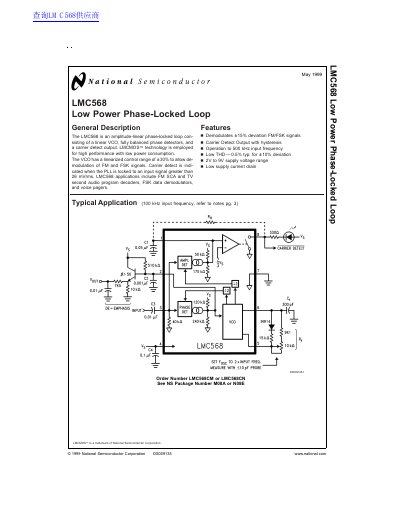
The LMC568 is an amplitude-linear phase-locked loop utilizing LMCMOS technology for high performance and low power consumption. It consists of a linear voltage-controlled oscillator (VCO), fully balanced phase detectors, and a carrier detect output. The device is designed to demodulate FM and FSK signals with a VCO linearized control range of ±30%.
| Supply Voltage Range | 2V to 9V |
|---|---|
| Operating Temperature Range | -25°C to +125°C |
| Input Frequency | 500 kHz |
| Total Harmonic Distortion | 0.5 % typ. |
| Power Supply Current (Typical) | 0.75 mA (5V) |
| Output Leakage Current | 100 nA |
| Center Frequency (Typical) | 90 kHz to 115 kHz (5V) |
| Package Types | M08A (Dual-In-Line), N08E (Small Outline) |
The device operates with a supply voltage range of 2V to 9V.
Applications include FM SCA and TV second audio program decoders, FSK data demodulators, and voice pagers.
The typical THD is 0.5% for ±10% deviation.