
This technical note introduces how to use the Hewlett-Packard 241 Protein Sequencer (N+C) N-Terminal 5.0 Biphasic Column Sequencer Methods to analyze proteins and peptides, including the principle, operating steps, precautions, etc.
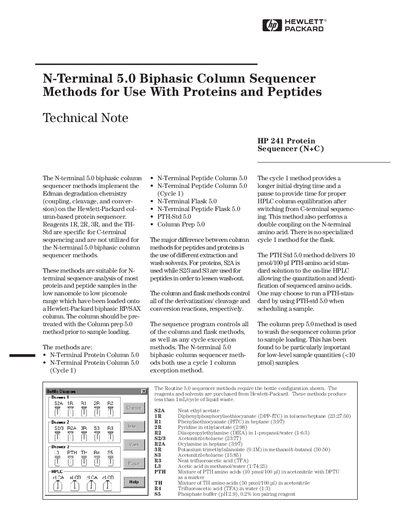
This document provides technical notes and methods for the N-terminal 5.0 biphasic column sequencer, designed for use with the Hewlett-Packard 241 Protein Sequencer (N+C). The methods implement Edman degradation chemistry for analyzing proteins and peptides in the low nanomole to low picomole range.
| Sample Range | low nanomole to low picomole |
|---|---|
| Standard Delivery | 10 pmol/100 pl |
| Column Configuration | reverse-phase (RP) sample column mated with a strong anion exchange (SAX) column |
It is used to wash the sequencer column prior to sample loading, which is particularly important for low-level sample quantities.
For proteins, 52A is used as an extraction and wash solvent, while 2/3 and 3 are used for peptides to lessen wash-out.
It provides a longer initial drying time and a pause for proper HPLC column equilibration after switching from C-terminal sequencing.