
This technical note introduces the advantages of using an orthogonal nebulizer orientation in electrospray for quantitative analysis of complex samples in quadrupole and ion trap mass spectrometers.
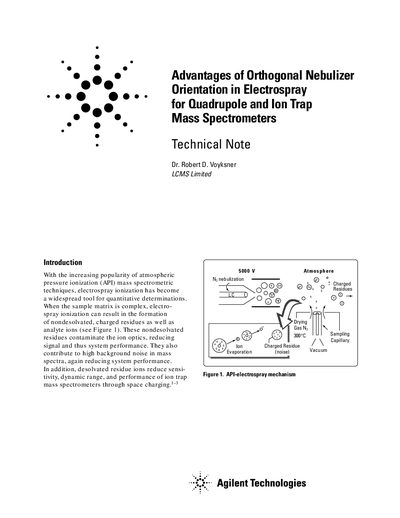
Electrospray ionization is a common technique for atmospheric pressure ionization mass spectrometry. However, complex sample matrices can create nondesolvated charged residues that contaminate the sampling orifice and ion optics, leading to high background noise and reduced performance in both quadrupole and ion trap systems.
This document presents experimental data demonstrating that off-axis (orthogonal) nebulization reduces these negative effects. By minimizing the number of charged particles entering the sampling orifice, orthogonal orientation improves system stability, dynamic range, and sensitivity while reducing contamination buildup.
Orthogonal nebulization reduces nondesolvated residues, contamination of the sampling orifice and ion optics, and improves sensitivity, precision, accuracy, and ruggedness.
It allows the system to maintain a constant response over long periods of analysis, preserving the necessary precision for quantitation.
Yes, it offers improved precision compared to on-axis configuration. For example, relative standard deviation was 5.6% for off-axis versus 14.1% for on-axis at a specific concentration.