
This document introduces the performance characteristics of the Agilent 1120 Compact LC, including high precision time and area, precise gradient formation and excellent signal-to-noise ratio
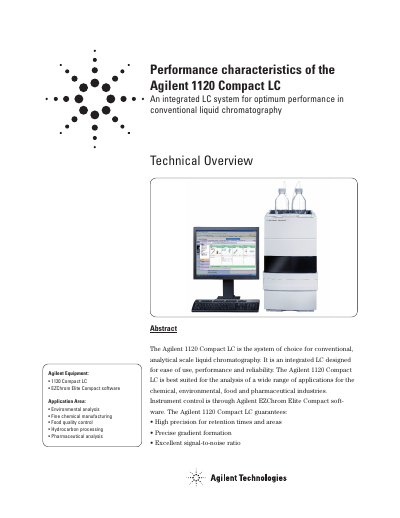
The Agilent 1120 Compact LC is an integrated liquid chromatography system designed for conventional analytical scale applications. It is controlled by Agilent EZChrom Elite Compact software and is best suited for the chemical, environmental, food, and pharmaceutical industries. The system guarantees high precision for retention times and areas, precise gradient formation, and an excellent signal-to-noise ratio.
This document describes the performance characteristics of the system through key measurements of the pump, autosampler, and detector. Specific evaluations include delay volume and composition accuracy, gradient precision and mixing noise, retention time precision, autosampler linearity and carryover, and detector baseline noise and drift.
| Delay volume | approximately 850 pL |
|---|---|
| Injection volume range | 0.1 up to 100 pL |
| Coefficient of correlation | 0.999998 |
The delay volume is approximately 850 pL.
The autosampler supports an injection volume range from 0.1 up to 100 pL without hardware modification.
The coefficient of correlation was 0.999998 for the tested range.