
Agilent's Multiple Affinity Removal System is a polyclonal antibody-based system that rapidly depletes multiple high-abundance proteins in serum, plasma or CSF. The system was launched in August 2003 and remains the leading technology in this market.
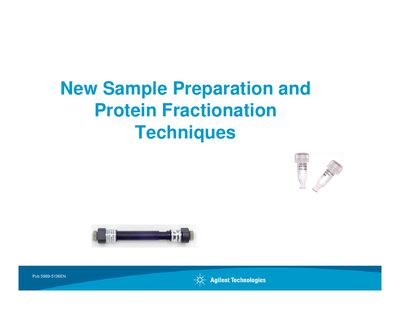
The document outlines Agilent Technologies' innovations in protein sample preparation and separation. It focuses on the Multiple Affinity Removal System (MARS), a polyclonal antibody-based system designed to rapidly deplete high-abundant proteins from serum, plasma, and CSF samples.
Key features highlighted include selectivity using native human plasma proteins as antigens, reproducibility in run-to-run and lot-to-lot performance, and ease of use with automated LC columns or reusable spin tubes. The text details the system's compatibility with downstream analyses such as 1D gel electrophoresis (1DGE), HPLC on mRP columns, and Mass Spectrometry (MS).
The automated single pass process takes a total of 30 minutes.
The reusable spin tube system depletes 15 uL of human serum or plasma.
The system achieves a depletion efficiency of 98-99%.