
Varian ELSD Polymer Blends Analysis Advantage Statement

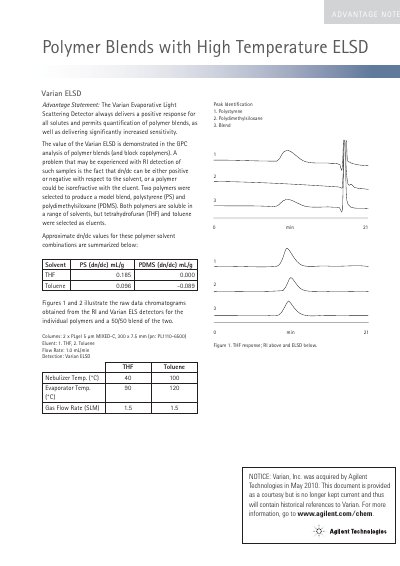
This document introduces the application of the Varian Evaporative Light Scattering Detector in the GPC analysis of polymer blends (and block copolymers).

Varian ELSD Polymer Blends Analysis Advantage Statement - cover page
Brand
Agilent
Document type
Product Leaflet
Language
English
Pages
2
File format
PDF
File size
177 KB
Published
05 July, 2012
Updated
30 September, 2023
MD5 checksum
2043560BEE994565FEE6D2FA64BCAC73

About this manual

The document presents an advantage statement for the Varian Evaporative Light Scattering (ELSD) detector. It demonstrates how ELSD overcomes limitations of Refractive Index (RI) detection when analyzing polymer blends where dn/de values may be positive, negative, or isorefractive. The text details a model blend analysis using Polystyrene and Polydimethylsiloxane.

What's inside

  • Polymer Blends Analysis
  • ELSD vs RI Detection
  • dn/de Values
  • GPC Applications
  • High Temperature Solvents

Frequently asked questions

What is the stated advantage of using a Varian ELSD for polymer blend analysis compared to RI detection?

The detector always delivers a positive response for all solutes and permits quantification of polymer blends, as well as delivering significantly increased sensitivity.

What are the specific operating temperatures used for the nebulizer and evaporator in the provided example?

The nebulizer temperature was set to 40°C or 100°C, while the evaporator temperature was set to 90°C or 120°C.

What is the flow rate specified for the eluent in the chromatogram examples?

The flow rate used for both THF and toluene was 1.0 mL/min.

Download PDF (177 KB)

More Agilent Manuals


View all Agilent manuals →