
This article introduces several label-free methods for the relative quantitation of proteins. These methods include comparing the mean peak area of all peptides identified for a protein in each sample, the peak area of a peptide found in both samples, the number of identified peptides in each sample, and the number of spectral hits in each sample.
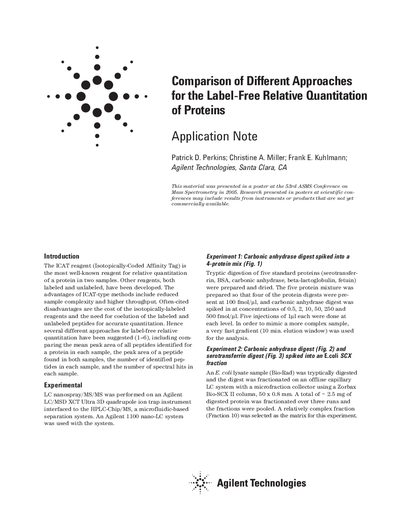
This document presents an application note comparing different methods for the label-free relative quantitation of proteins. The study evaluates techniques such as mean peak area, total peak intensity, peptide counts, and spectral hits against known concentrations.
Experiments were conducted using an Agilent LC/MSD XCT Ultra 3D quadrupole ion trap instrument interfaced with an HPLC-Chip/MS system. Various protein mixtures, including carbonic anhydrase spiked into a multi-protein mix and E. coli fractions, were analyzed to determine the linearity and reliability of each quantitation approach.
The approach using total peptide precursor ion intensity showed by far the best results with a true linear relationship over three orders of magnitude.
The experiments were performed on an Agilent LC/MSD XCT Ultra 3D quadrupole ion trap instrument interfaced to the HPLC-Chip/MS.
Protein digest mixture data were searched using Agilent Spectrum Mill MS Proteomics Workbench software.