
This document describes the application of the Agilent Cell Viability Workstation and Promega CellTiter-Glo kit. The Agilent Cell Viability Workstation consists of a Molecular Devices SpectraMax M5 and an Agilent BenchCel Microplate Handling Workstation integrated with an Agilent Bravo Automated Liquid Handling Platform. This workstation is designed for automated cell viability testing and features a compact footprint and high-throughput processing capability. The Promega CellTiter-Glo kit utilizes a linear relationship between ATP concentration and light signal, measuring the ATP content in cells through the generation of luminescence to determine the number of viable cells.
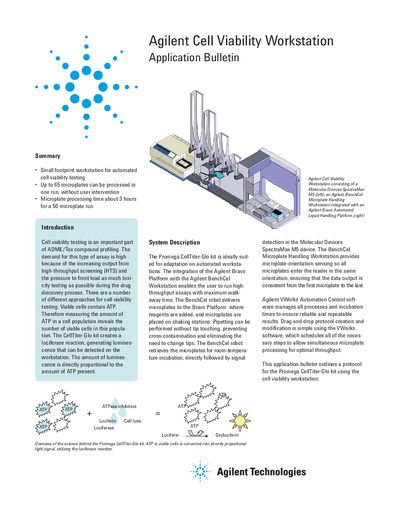
This document outlines a protocol for the Promega CellTiter-Glo kit using the Agilent Cell Viability Workstation. The system integrates the Agilent BenchCel Workstation with the Agilent Bravo Platform and a Molecular Devices SpectraMax M5 reader to automate cell viability testing. The process involves moving microplates between stackers, adding reagents via the Bravo platform, shaking, incubating, and reading luminescence to determine the number of viable cells based on ATP content.
| Maximum microplates per run | Up to 65 microplates |
|---|---|
| Typical processing time | About 3 hours for 50 microplates |
| Compatible kit | Promega CellTiter-Glo kit |
The typical throughput is about 3 hours for 50 microplates, depending on the exact protocol and liquid-handling steps.
Stacker 1 can store up to 65 microplates.
The protocol measures ATP in viable cells, which generates luminescence via a luciferase reaction.