
This Application Note demonstrates: (1) The use of the Agilent 1200 Rapid Resolution LC (RRLC) system for high resolution separation of metabolites from an in-vitro metabolism experiment. (2) The use of the Agilent 6520 QTOF mass spectrometer for the acquisition of data for computer assisted metabolite identification. (3) The use of the Agilent MassHunter Metabolite identification software for highly productive identification of expected metabolites. (4) The results of the Metabolite ID data analysis for expected metabolites of the pharmaceutical drug nefazodone.
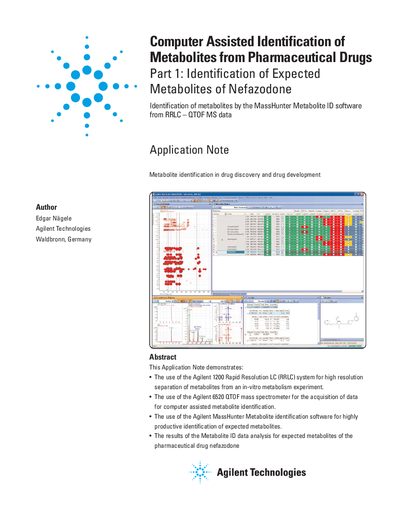
This document describes a method for the computer-assisted identification of metabolites from pharmaceutical drugs, specifically using nefazodone as a benchmark compound. It details the experimental setup involving the Agilent 1200 Rapid Resolution LC system and the Agilent 6500 Series Accurate Mass QTOF mass spectrometer.
The text explains the data analysis workflow within the MassHunter Metabolite ID software, which utilizes multiple cooperative algorithms to analyze QTOF MS and MS/MS data. The document presents results for the identification of expected metabolites, including a mono-hydroxy metabolite of nefazodone, by comparing isotope patterns and fragmentation data against the parent drug.
Compounds are considered potential metabolites if they are new or increased by at least 2-fold in the metabolized sample.
The sample must be vortexed and incubated for 1 hour at 37°C.
The flow rate for the method is set to 0.5 mL/min.