
This document describes the analysis method for PVC using gel permeation chromatography (GPC).
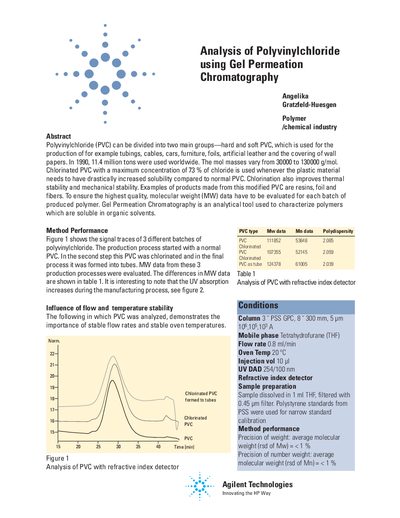
This document details the analysis of Polyvinylchloride (PVC) using Gel Permeation Chromatography (GPC) to evaluate molecular weight data for different batches of polymer. It covers the analysis of normal PVC, chlorinated PVC, and PVC formed into tubes, demonstrating how molecular weight varies during the manufacturing process.
| Column | 3 x 300 mm, 5 um PSS GPC |
|---|---|
| Mobile phase | Tetrahydrofurane (THF) |
| Flow rate | 0.8 ml/min |
| Oven Temp | 20 °C |
| Injection vol | 10 ul |
| UV DAD | 254/100 nm |
| Flow rate (optimized) | 0.2 ml/min |
| Oven Temp (optimized) | 40 °C |
| Injection vol (optimized) | 40 ul |
The optimized conditions use an Agilent 1100 Series HPLC system including an isocratic pump, degasser, autosampler, thermostatted column compartment, and diode array detector.
The precision of weight average molecular weight is less than 1% relative standard deviation.
Flow changes as small as 0.5% have an influence on the precision of the molecular weight data.