
This paper describes the method of analyzing sulfur anions in Kraft liquors using capillary electrophoresis in the chemical recovery process at a Kraft pulp mill. Sulfur anions, such as sulfate in the black liquor, are converted to sulfide anions in the green liquor. Sulfide anions in the pulping reactions produce stronger paper, but if their concentration is too low, the paper loses its strength, and if the concentration is very high, polluting emissions from the Kraft recovery furnaces are increased. Wet chemical tests and Ion Chromatography (IC) have traditionally been used to analyze process liquors. However, capillary electrophoresis is a suitable replacement for IC due to its benefits of less buffer consumption, less maintenance, and considerably shorter run times.
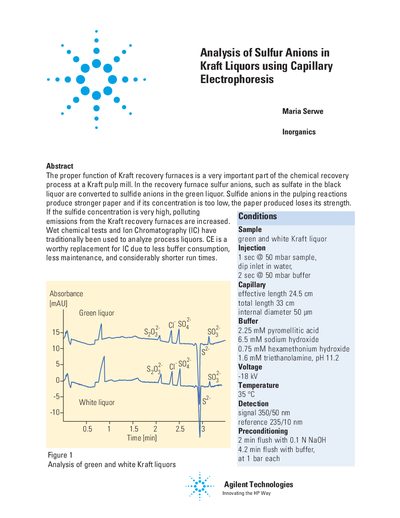
This document details the use of Capillary Electrophoresis (CE) as a method to analyze sulfur anions (sulfide, sulfate, thiosulfate, and sulfite) in Kraft liquors for the pulp and paper industry. It highlights CE as a replacement for Ion Chromatography (IC) due to benefits such as less buffer consumption, less maintenance, and shorter run times. The note explains that monitoring these anions is crucial for controlling the chemical recovery process and ensuring paper strength while minimizing polluting emissions.
| Assay linear range | 10 to 100 ppm |
|---|---|
| Detection limit | approximately 1 ppm |
| Standard concentration | 10,000 ppm sulfide, sulfate, Cl |
| Sample dilution | 1:200 with water |
CE is a worthy replacement for IC due to less buffer consumption, less maintenance, and considerably shorter run times.
The analysis is performed using the Agilent Capillary Electrophoresis system equipped with diode array detection and computer control via the Agilent Chemstation.