
This document describes the process control of polyamide-6,6, which is widely used in the textile, construction, and electronic industries. The properties of polyamide-6,6 depend on its molecular weight and molecular weight distribution.
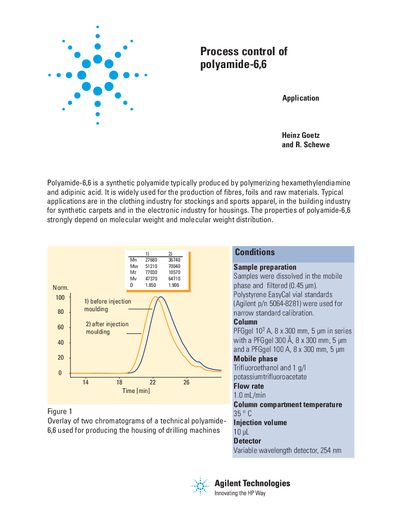
Polyamide-6,6 is a synthetic polymer widely used in industries such as clothing, building materials, and electronics. Its properties depend heavily on molecular weight and distribution, which can change during the injection moulding process.
The document details an analytical method using GPC-SEC (Gel Permeation Chromatography - Size Exclusion Chromatography) to monitor these changes. It specifies the use of trifluoroethanol as a mobile phase and potassium trifluoroacetate to reduce adsorption, utilizing Agilent 1100 Series equipment.
The samples are dissolved in a mobile phase consisting of trifluoroethanol and 1 g/l potassium trifluoroacetate.
The flow rate for the analysis is set to 1.0 mL/min.