
Agilent 1100 Series Analysis of Brenzcatechol Additive in Styrene using HPLC Application Note

This application note describes the method for analyzing brenzcatechine (TBC) additive in styrene using Agilent HPLC.
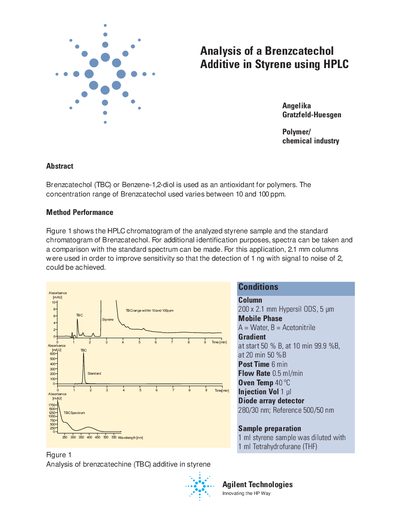

Agilent 1100 Series Analysis of Brenzcatechol Additive in Styrene using HPLC Application Note - cover page
Brand
Agilent
Document type
Application Note
Language
English
Pages
2
File format
PDF
File size
149 KB
Published
02 July, 2012
Updated
30 September, 2023
MD5 checksum
5DEC1FC0E0F4624B788FC71E29B7813B

About this manual

The document details a High-Performance Liquid Chromatography (HPLC) method for analyzing Brenzcatechol (TBC), used as an antioxidant in polymers, within styrene samples. The concentration range of interest is between 10 and 100 ppm.

To achieve high sensitivity capable of detecting 1 ng with a signal-to-noise ratio of 2, the method utilizes 2.1 mm columns (specifically Hypersil ODS). The setup includes an Agilent 1100 Series system equipped with a degasser, binary pump, autosampler, thermostatted column compartment, and diode array detector.

What's inside

  • Abstract
  • Method Performance
  • Conditions
  • Sample preparation
  • Equipment

Frequently asked questions

What is the concentration range of Brenzcatechol used in polymers?

The concentration varies between 10 and 100 ppm.

What column dimensions were used to improve sensitivity for this analysis?

2.1mm columns were used in order to improve sensitivity.

What is the limit of detection (LOD) for Brenzcatechol with a signal-to-noise ratio of 2?

The LOD is 1 ng or 1 ppm.

Download PDF (149 KB)

More Agilent Manuals


View all Agilent manuals →