
Retention time locking (RTL) can be used to lock retention times with chromatographic instruments, columns, and different types of detectors, which increases laboratory productivity.
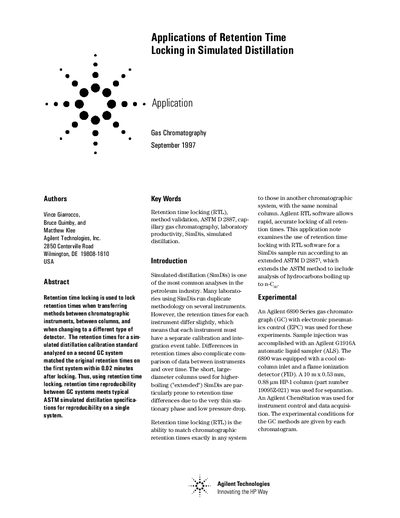
This document describes the use of Agilent RTL software to lock retention times when transferring methods between chromatographic instruments or changing detectors. The primary goal is to ensure that retention times for a simulated distillation calibration standard analyzed on a second GC system match the original retention times on the first system within 0.02 minutes, thereby meeting typical ASTM simulated distillation specifications for reproducibility on a single system.
The note details an experiment using an Agilent 6890 Series gas chromatograph with electronic pneumatics control (EPC) and an automatic liquid sampler. By adjusting the inlet pressure of a second GC system using the RTL software, the retention time deviation was reduced from a typical 0.15 to 0.3 minutes to as little as 0.02 minutes. This allows for the use of a common universal boiling point calibration curve based on locked GC systems, saving time and increasing data value.
| Retention time match tolerance | 0.02 minutes |
|---|---|
| Column dimensions | 10m x 0.53 mm, 0.88 um |
| Carrier gas | Helium |
| Oven program range | 35 °C to 375 °C |
It is used to lock retention times when transferring methods between chromatographic instruments, between columns, and when changing to a different type of detector.
It allows for a common universal boiling point calibration curve based on locked GC systems, which saves time and increases the value of the data.