
This document introduces a new product (Application 460B-00) from Agilent Technologies/Wasson-ECE, which uses a 5973N GC/MSD (gas chromatograph/mass selective detector) to determine trace levels of impurities in ethylene and propylene. The product shows comparable performance in terms of linearity and repeatability compared to GC/FID or GC/TCD. The sensitivity of GC/MSD is increased 50-fold compared to GC/FID, and 5000-fold compared to GC/TCD.
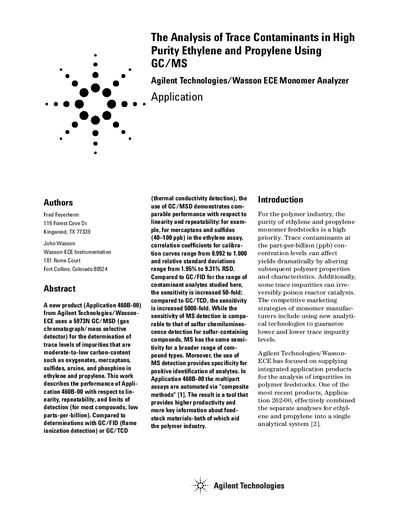
Agilent Technologies/Wasson-ECE has developed Application 460B-00, an integrated system for analyzing trace contaminants in polymer feedstocks. This application note details the performance of the system in detecting moderate-to-low carbon-content impurities such as oxygenates, mercaptans, sulfides, arsine, and phosphine in high-purity ethylene and propylene. The document compares the system's performance against GC/FID and GC/TCD methods, highlighting significant improvements in sensitivity and the ability to positively identify analytes through mass spectrometry.
The analysis utilizes a modular approach combining a gas chromatograph (6890 GC) with a mass selective detector (5973 MSD) and a multivalve, multicolumn configuration. The system employs Composite Analysis Control Software (CACS) to automate sequential injections and method execution, providing a tool for higher productivity and detailed information on feedstock materials to aid the polymer industry.
| Mass Spectrometer Model | 5973 MSD and later models |
|---|---|
| Gas Chromatograph Model | 6890 GC |
| Analysis Time per Sample | about 1 hour |
| Detection Sensitivity Increase vs GC/FID | 50-fold |
| Detection Sensitivity Increase vs GC/TCD | 5000-fold |
The system determines trace levels of impurities such as oxygenates, mercaptans, sulfides, arsine, and phosphine.
Compared to GC/FID, the sensitivity is increased 50-fold for the range of contaminant analytes studied.
The system uses Composite Analysis Control Software (CACS) to automatically sequence sampling and apply methods.