
This document introduces the use of AC Oxygenate Analyzer, including instrument configuration, analysis conditions and chromatograms.
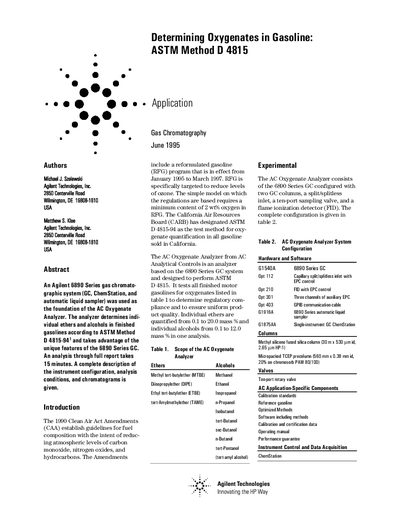
This document details the configuration of an AC Oxygenate Analyzer based on the Agilent 6890 Series gas chromatographic system. The system is designed to determine individual ethers and alcohols in finished gasolines, complying with ASTM Method D 4815-94. The analysis utilizes a split/splitless inlet, a ten-port sampling valve, and a flame ionization detector (FID).
| Analysis Time | 15 minutes |
|---|---|
| Ethers Quantification Range | 0.1 to 20.0 mass % |
| Alcohols Quantification Range | 0.1 to 12.0 mass % |
| Injection Port Temperature | 200°C |
| FID Temperature | 250°C |
| Carrier Gas | Helium |
| Split Ratio | 15:1 |
The analyzer determines oxygenates according to ASTM Method D 4815-94.
Using Electronic Pneumatics Control (EPC) reduces the analysis time by approximately 40%.
The analyzer quantifies ethers like MTBE, ETBE, TAME, DIPE, and alcohols like methanol, ethanol, and various propanols/butanol.