
The document describes the application of the Agilent Bravo Automated Liquid Handling Platform in quantitative polymerase chain reaction (QPCR) assays. It has been shown that the Bravo platform can effectively automate the setup of various QPCR assays and has similar slopes and good linearity compared to manual setup. Dilution samples set up by both methods showed similar slopes and good linearity, and the target genes amplified by both methods also had similar Ct values. When examining cDNA from fetal and adult lung tissues, differential expression was observed in the B2M gene, while expression of the GUSB and TBP genes remained similar. The Bravo Automated Liquid Handling Platform is useful for scientists who want to speed up setup while maintaining reliability in QPCR studies.
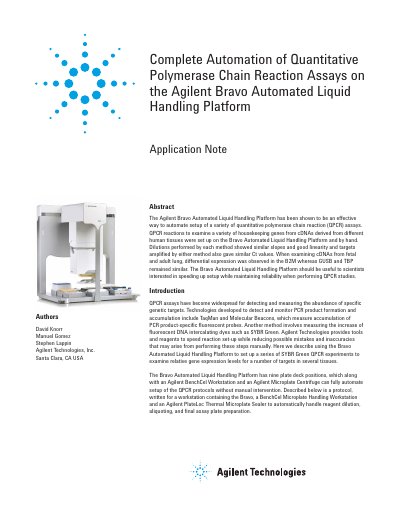
The document details a study comparing quantitative polymerase chain reaction (QPCR) assays set up manually versus those automated on the Agilent Bravo Automated Liquid Handling Platform. The platform was used in conjunction with an Agilent BenchCel Workstation and an Agilent PlateLoc Thermal Microplate Sealer to fully automate reagent dilution, aliquoting, and final assay plate preparation for SYBR Green experiments.
Results showed that reactions prepared by the Bravo yielded similar slopes, linearity, and Ct values compared to hand-pipetted controls. The study examined housekeeping genes from cDNAs derived from human tissues (fetal and adult lung, heart, and HeLa cells), confirming that the automated method maintains data quality while increasing throughput.
The protocol combines 250 pg of cDNA template diluted to 10 µL in water.
Reactions were developed using a thermal cycler for 40 cycles.
The templates were derived from RNA at a concentration of 500 pg/µL.