
This Application Note describes the development of a rapid resolution LC method for the separation of the Chinese herbal prescription Zuo Jin Pill into its six major con- stituents: magnoflorine, jatrorrhizine, coptisine, palmatine, berberine and evodiamine. The method uses an Agilent 1200 Series Rapid Resolution Liquid Chromatography (RRLC) system coupled with an Agilent 1200 Series Diode Array Detector (DAD). The separation was carried out on an Agilent ZORBAX Eclipse Plus C18 column (4.6 × 150 mm, 1.8 µm). The linear gradient was eluted with the mobile phase of an acetoni- trile – acetate buffer. All calibration curves showed good linearity (r2 >0.9998) within the test range 1.2-1200 µg/ml. The results demonstrate that this analytical method is simple, sensitive and reliable for rapidly analyzing six major bioactive compounds in ZJPs. It is useful for the comprehensive evaluation of the quality of this traditional Chinese Medicine (TCM).
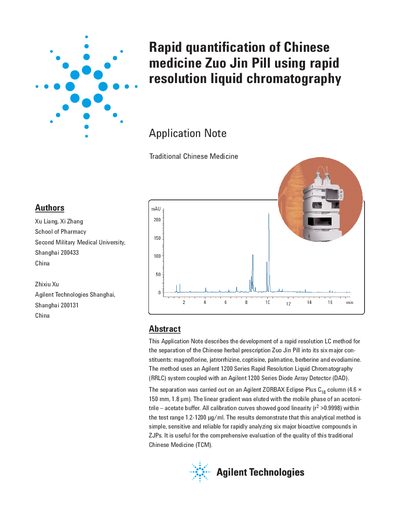
This document details the development and validation of a rapid resolution liquid chromatography (RRLC) method for the simultaneous quantification of six bioactive compounds in the traditional Chinese medicine Zuo Jin Pill (ZJP). The method utilizes an Agilent 1200 Series RRLC system coupled with a Diode Array Detector (DAD) and a ZORBAX Eclipse Plus C18 column.
The study compares the performance of this RRLC method against traditional high-performance liquid chromatography (HPLC). Results indicate that the RRLC method achieves comparable separation quality with a significantly shorter analysis time (18 minutes versus 70 minutes) and requires less solvent. The method was validated for linearity, precision, accuracy, and recovery, demonstrating high sensitivity and reliability for quality evaluation of Zuo Jin Pill.
| Column | Agilent ZORBAX Eclipse Plus C18 Rapid Resolution High Throughput (RRHT) column (4.6 x 150 mm, 1.8 pm) |
|---|---|
| Flow rate | 1.2 mL/min |
| Column temperature | 35 °C |
| DAD wavelength | 254nm |
| Injection volume | 5 pL |
| Correlation coefficient | r2 > 0.9998 |
The analysis was performed using an Agilent 1200 Series RRLC system with a Diode Array Detector.
The RRLC method achieves comparable separations in 18 minutes, whereas the HPLC method requires 70 minutes.
The method analyzes magnoflorine, jatrorrhizine, coptisine, palmatine, berberine, and evodiamine.