
The PDU1016H is a 4-bit, ECL-interfaced digitally programmable delay line that can be digitally programmed in 16 delay steps. The product features monotonic delay-versus-address variation, precise and stable delays, and fully 10KH-ECL interfaced and buffered inputs and outputs.
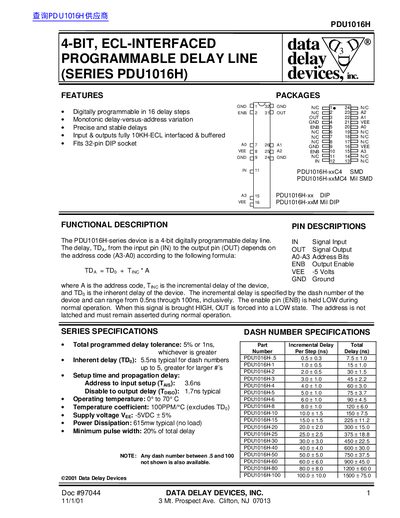
The PDU1016H-series device is a 4-bit digitally programmable delay line featuring ECL interfacing and buffering. It offers 16 programmable delay steps with monotonic delay-versus-address variation, allowing precise and stable delays. The device fits a 32-pin DIP socket and is available in various packages including DIP and SMD.
| Total programmed delay tolerance | 5% or 1ns, whichever is greater |
|---|---|
| Operating temperature | 0° to 70° C |
| Temperature coefficient | 100PPM/°C |
| Power Dissipation | 615mw typical (no load) |
| Minimum pulse width | 20% of total delay |
The delay (TDa) depends on the address code (A) according to the formula: TDa = TDp + Tinc * A.
The incremental delay can range from 0.5ns through 100ns, inclusively.
When the ENB signal is brought HIGH, the output (OUT) is forced into a LOW state.