
This document describes the features and characteristics of the 3D7428 monolithic 8-bit programmable delay line. The delay line uses all-silicon, low-power CMOS technology and has TTL/CMOS compatible inputs and outputs. It can be programmed via a serial or parallel interface. The delay can be varied from 0.25 to 20.0ns with a delay tolerance of 0.5%. The supply current is 3mA, temperature stability is ±1.5% (-40C to 85C), and Vdd stability is ±0.5% (4.75V to 5.25V). The product is available in multiple package options and is solderable.
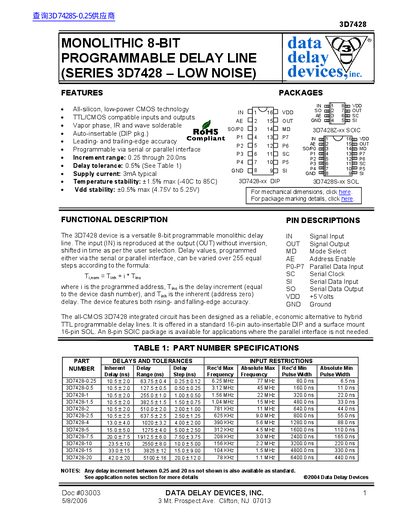
The 3D7428 device is a monolithic 8‑bit programmable delay line that reproduces the input signal at the output with a selectable time shift. It supports both TTL and CMOS compatible inputs and outputs, offers a wide increment range, and is available in DIP, SOL and SOIC packages. Programming can be performed via a serial or parallel interface, allowing up to 255 address steps.
The datasheet provides extensive electrical characteristics, including supply current, temperature stability, VDD stability, and timing parameters such as clock frequency and rise/fall times. Detailed application notes cover delay accuracy, stability, input signal requirements, and programming procedures, along with test setup recommendations.
| Increment range | 0.25 ns to 20 ns |
|---|---|
| Typical supply current | 3 mA |
| Temperature stability | +1.5 % max (‑40 °C to 85 °C) |
| VDD stability | +0.5 % max (4.75 V to 5.25 V) |
| Clock frequency (max) | 80 MHz |
| Static supply current (typ) | 3 mA |
| High‑level input voltage | 2.0 V |
| Low‑level input voltage | 0.8 V |
| Output rise/fall time | 2.0 ns to 2.5 ns |
The device supports delay increments from 0.25 ns up to 20 ns.
The recommended maximum operating frequency is listed in Table 1 (e.g., 6.25 MHz for the 0.25 ns part) and the recommended minimum pulse width is given as a percentage of total delay in the specifications.
It can be programmed via either a serial interface (using clock, data, and enable signals) or a parallel interface (using pins P0‑P7 and an address enable latch).
Typical supply current is about 3 mA.