
The M54HC4538/M74HC4538 is a high performance CMOS bistable multivibrator fabricated in silicon gate C2MOS technology. It has the same high performance as LSTTL combined with true CMOS low power consumption. Each multivibrator features both a negative, A, and a positive, B, edge triggered input, either of which can be used as an inhibit input. Also included is a clear input that when taken low resets the one shot. The monostable multivibrators are retriggerable. That is, they may be triggered repeatedly while their outputs are generating a pulse and the pulse will be extended. Pulse width stability over a wide range of temperature and supply is achieved using linear CMOS techniques. The output pulse equation is simply PW = 0.7 (R)(C) where R is the output resistance and C is the output capacitance.
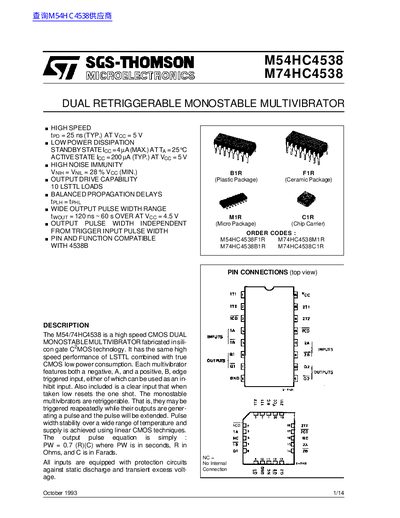
The document describes the M54/74HC4538, a high-speed CMOS dual monostable multivibrator fabricated in silicon gate CMOS technology. It combines LSTTL speed with low power consumption, featuring both negative and positive edge-triggered inputs for each channel.
Key specifications include a typical propagation delay of 25 ns at 5V supply voltage and a maximum standby current of 4 µA. The device supports a wide output pulse width range from 120 ns to 60 seconds, independent of the trigger input pulse width.
| Propagation Delay (Typical) | 25 ns at Vcc=5V |
|---|---|
| Standby Current (Max) | 4 µA at Ta=25°C |
| Active Current (Typical) | 200 pA at Vcc=5V |
| Output Drive Capability | 10 LSTTL Loads |
| Supply Voltage Range (Operating) | 2 to 6 V |
The output pulse width is calculated as PW = 0.7(R)(C), where R is in Ohms and C is in Farads.
Yes, each multivibrator features both a negative edge-triggered input (A) and a positive edge-triggered input (B).