
This Application Note describes the application of ternary and quaternary gradients in reversed phase chromatography. Ternary and quaternary gradients are rarely used in method development, but they can be very helpful in finding optimized conditions for a separation. In this Application Note, binary, ternary, and quaternary gradients are applied and compared. Performance data, including resolution and precision of retention time are evaluated and the results show that these gradients are a useful tool.
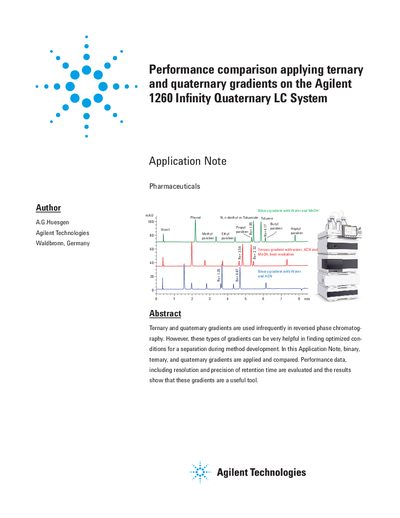
This document evaluates the performance of binary, ternary, and quaternary gradients in reversed-phase chromatography using an Agilent 1260 Infinity LC System. The study focuses on optimizing separation conditions for specific compounds while maintaining constant ionic strength.
Two primary examples are analyzed: a mixture containing parabens, toluene, phenol, and N,N-diethyl-m-toluamide; and the analysis of tramadol and its related impurities. Results demonstrate that ternary and quaternary gradients offer superior resolution and signal-to-noise ratios compared to binary methods in these specific scenarios.
| Column | Agilent ZORBAX Eclipse Plus C18, 3mm x 100 mm, 3.5 µm |
|---|---|
| Flow rate | 1.2 mL/min |
| Column temperature | 40 °C |
| Detector wavelength | 254/10 nm, Ref 360/100 nm |
They are used to optimize separation conditions during method development while keeping ionic strength constant.
The ternary gradient with acetonitrile and methanol provided the best compromise between resolution and run time.
It optimizes separation by providing a better compromise between resolution, signal-to-noise, and run time compared to ternary gradients.