
This application note introduces the basic principles and techniques of atomic force microscopy (AFM) spectroscopy and discusses various methods for AFM spectroscopy. The application note also provides examples of how to use AFM spectroscopy techniques to study various materials and applications.
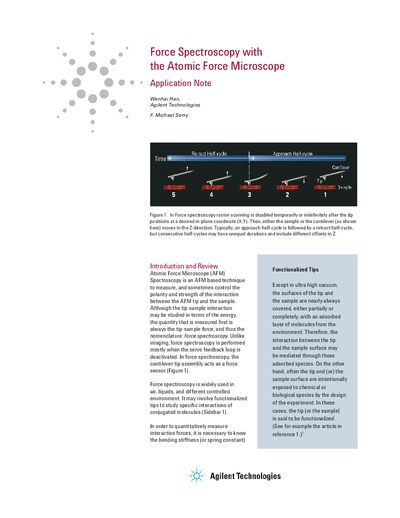
This document describes force spectroscopy, an Atomic Force Microscope (AFM) based technique used to measure and control the polarity and strength of interactions between an AFM tip and a sample. Unlike imaging, this technique is performed mostly when the servo feedback loop is deactivated, allowing the cantilever-tip assembly to act as a force sensor.
The quantity that is always measured first is the tip-sample force.
Force spectroscopy is widely used in air, liquids, and different controlled environments.
The majority of applications have so far involved molecular or nanometer-scale resolution.