
This method is for the determination of the statistical or randomly distributed ethylene content of ethylene-propylene copolymers. The determination is specific for ethylene and cannot be applied for the quantitation of other comonomers. The method has been validated over the range of 0.3 to 3.5% statistical content and can be used for either powder or pellet samples. Certain sorbitol-based clarifiers have been found to interfere with the determination and therefore a correction factor is necessary for resins containing these additives. This method is generally not recommended for quantitation of ethylene in filled or pigmented resins.
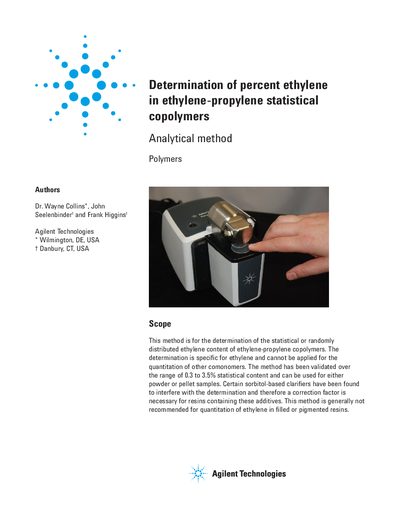
This application note details a procedure for measuring the statistical ethylene content in ethylene-propylene statistical copolymers using infrared spectroscopy. The method utilizes an absorption band at 733 cm⁻¹ associated with statistically distributed ethylene and is validated for the range of 0.3 to 3.5% statistical content. It is applicable to both powder and pellet samples, though certain sorbitol-based clarifiers may require a correction factor.
The procedure involves molding a representative sample into a film of 0.5 to 0.7 mm thickness and analyzing it using an Agilent Cary 630 FTIR spectrometer equipped with a DialPath or TumbllR accessory. The concentration is determined by comparing the normalized absorbance of the ethylene peak relative to a polypropylene reference peak against a calibration curve derived from NMR standards.
| Validated range | 0.3 to 3.5% statistical content |
|---|---|
| Sample thickness | 0.5 and 0.7 mm |
| Spectrometer resolution | 4 wavenumbers |
| Minimum collection time | 30 seconds |
| Press temperature | 200 °C |
| Maximum resin temperature | 250 °C |
No, this method is generally not recommended for quantitation of ethylene in filled or pigmented resins.
Certain sorbitol-based clarifiers have been found to interfere with the determination.
The Agilent DialPath or TumbllR accessories are used to insert the film or coupon into the infrared beam path.