
This method is for the determination of the number of vinyl groups (C=C) in polyethylene resins by infrared spectroscopy. The test is used primarily for resins made with chromium catalyst technology, which gives a vinyl group at the end of each polymer chain, rather than resins made with titanium-based catalysts, which have few unsaturation sites. The method is applicable to powder, pellets or pieces cut from finished parts, but cannot be used for filled or pigmented samples.
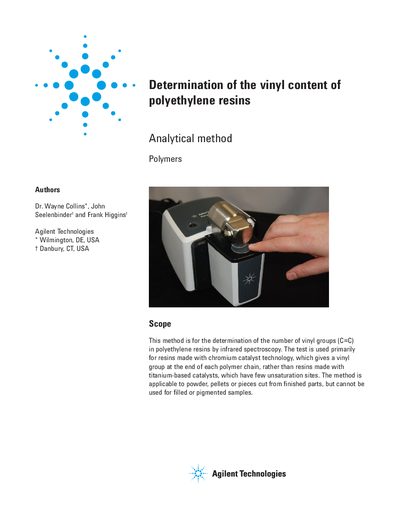
This document outlines an analytical method for determining the number of vinyl groups (C=C) per 1000 carbon atoms in polyethylene resins using infrared spectroscopy. The method is primarily applicable to resins made with chromium catalyst technology and is suitable for powder, pellets, or cut pieces, but not filled or pigmented samples. The analysis relies on relating the intensity of the infrared absorption vinyl band at 908 cm-1 to a calibration curve derived from nuclear magnetic resonance (NMR) measurements.
| Sample thickness | 0.4 to 0.5 mm |
|---|---|
| Maximum molding temperature | 250 °C |
| Spectrometer resolution | 2 wavenumber |
| Minimum collection time | 30 seconds |
| Calibration equation slope | 2.751 |
| Calibration equation intercept | -0.111 |
The test is used primarily for resins made with chromium catalyst technology.
No, the method cannot be used for filled or pigmented samples.
Resins from titanium catalysts typically have low vinyl content, less than 0.5 vinyls/1000 carbon atoms.