
The MIC5256 is an efficient, precise CMOS voltage regulator. It offers better than 1% initial accuracy, extremely low-dropout voltage (typically 135mV at 150mA) and low ground current (typically 90µA) over load. The MIC5256 features an error flag that indicates an output fault condition such as overcurrent, thermal shutdown and dropout. Designed specifically for handheld and battery-powered devices, the MIC5256 provides a TTL-logic-compatible enable pin. When disabled, power consumption drops nearly to zero. The MIC5256 also works with low-ESR ceramic capacitors, reducing the amount of board space necessary for power applications, critical in hand-held wireless devices. Key features include current limit, thermal shutdown, faster transient response, and an active clamp to speed up device turnoff. Available in the IttyBitty™ SOT-23-5 package and the new Thin SOT-23-5, which offers the same footprint as the standard IttyBitty™ SOT-23-5, but only 1mm tall. The MIC5256 offers a range of output voltages.
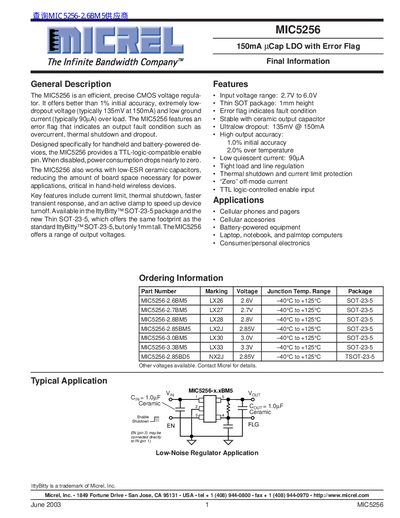
The MIC5256 is an efficient CMOS voltage regulator designed specifically for handheld and battery-powered devices. It offers better than 1% initial accuracy, extremely low dropout voltage (typically 135mV at 150mA), and low ground current. The device features a TTL-logic-compatible enable pin that reduces power consumption to nearly zero when disabled.
Key characteristics include an error flag indicating overcurrent or thermal shutdown conditions, stability with low-ESR ceramic capacitors, and availability in the IttyBitty SOT-23-5 package and the new Thin SOT-23-5. The regulator provides a range of output voltages from 2.6V to 3.3V.
| Output Current | 150mA |
|---|---|
| Input Voltage Range | 2.7V to 6.0V |
| Dropout Voltage (Typical) | 135mV @ 150mA |
| Output Accuracy | Better than 1% |
| Quiescent Current (Typical) | 90uA |
| Package Types | SOT-23-5, TSOT-23-5 |
| Operating Temperature Range | -40°C to +125°C |
The typical dropout voltage is 135mV when the output current is 150mA.
Yes, it features an error flag that indicates output fault conditions such as overcurrent or thermal shutdown.
Yes, the device works with low-ESR ceramic capacitors to reduce board space.