
The MAX9390/MAX9391 dual 2 x 2 crosspoint switches perform high-speed, low-power, and low-noise signal distribution. The MAX9390/MAX9391 multiplex one of two differential input pairs to either or both low-voltage differential signaling (LVDS) outputs for each channel. Independent enable inputs turn on or turn off each differential output pair. Four LVCMOS/LVTTL logic inputs (two per channel) control the internal connections between inputs and outputs. This flexibility allows for the following configurations: 2 x 2 crosspoint switch, 2:1 mux, 1:2 splitter, or dual repeater. This makes the MAX9390/MAX9391 ideal for protection switching in fault-tolerant systems, loopback switching for diagnostics, fanout buffering for clock/data distribution, and signal regeneration. Fail-safe circuitry forces the outputs to a differential low condition for undriven inputs or when the common-mode voltage exceeds the specified range. The MAX9390 provides high-level input fail-safe detection for LVDS, HSTL, and other GND-referenced differential inputs. The MAX9391 provides low-level input fail-safe detection for LVPECL, CML, and other VCC-referenced differential inputs. Ultra-low 82ps(P-P) (max) pseudorandom bit sequence (PRBS) jitter ensures reliable communications in high-speed links that are highly sensitive to timing error, especially those incorporating clock-and-data recovery, or serializers and deserializers. The high-speed switching performance guarantees 1.5
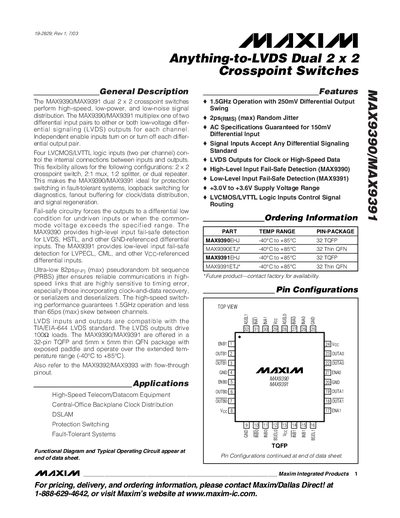
The MAX9390/MAX9391 are dual 2 x 2 crosspoint switches designed to perform high-speed, low-power, and low-noise signal distribution. These devices multiplex one of two differential input pairs to either or both low-voltage differential signaling (LVDS) outputs for each channel, supporting configurations such as a 2x2 crosspoint switch, 2:1 mux, 1:2 splitter, or dual repeater.
The MAX9390 provides high-level input fail-safe detection suitable for LVDS and HSTL inputs, while the MAX9391 offers low-level input fail-safe detection for LVPECL and CML inputs. Both devices operate up to 1.5GHz with ultra-low jitter, ensuring reliable communications in high-speed links sensitive to timing errors.
| Operating Frequency | 1.5GHz |
|---|---|
| Supply Voltage Range | +3.0V to +3.6V |
| Operating Temperature Range | -40°C to +85°C |
| Package Types | 32-pin TQFP, 32 Thin QFN |
| Differential Output Voltage Swing | 250mV (typical) |
The MAX9390 provides high-level input fail-safe detection for LVDS/HSTL, while the MAX9391 provides low-level input fail-safe detection for LVPECL/CML.
The devices support 2 x 2 crosspoint switch, 2:1 mux, 1:2 splitter, or dual repeater configurations.