
This document discusses the understanding and application of voltage references, including the accuracy of references and tips for maximizing their performance.
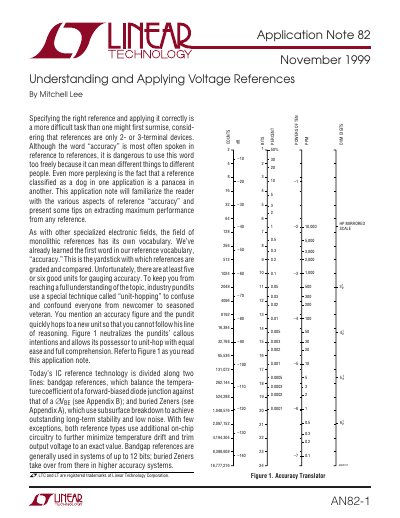
Understanding and applying voltage references correctly is a complex task involving various aspects of 'accuracy.' This document serves as a guide for circuit designers, explaining that while references are simple 2- or 3-terminal devices, selecting the right one requires careful consideration of specifications like initial accuracy, temperature coefficient (tempco), long-term stability, and noise. The text clarifies that industry terminology can be confusing due to different units used to express these metrics.
The document details two primary types of monolithic reference technology: bandgap references and buried Zeners. Bandgap references are generally suited for systems up to 12 bits, while buried Zeners offer higher accuracy for more demanding applications. The text further discusses how temperature-induced changes can overshadow initial accuracy and explains methods like the 'box' method for calculating tempco over an operating range.
Monolithic reference initial accuracy ranges from 0.02% to 1%, representing a 1LSB error in systems ranging from 6-bit to 12-bit.
Buried Zeners typically perform better than 20ppm/√kh, whereas bandgaps usually fall between 20ppm and 50ppm/√kh.